
Ep . 57: Your Company Wasn’t Built to Grieve with Molly Graham
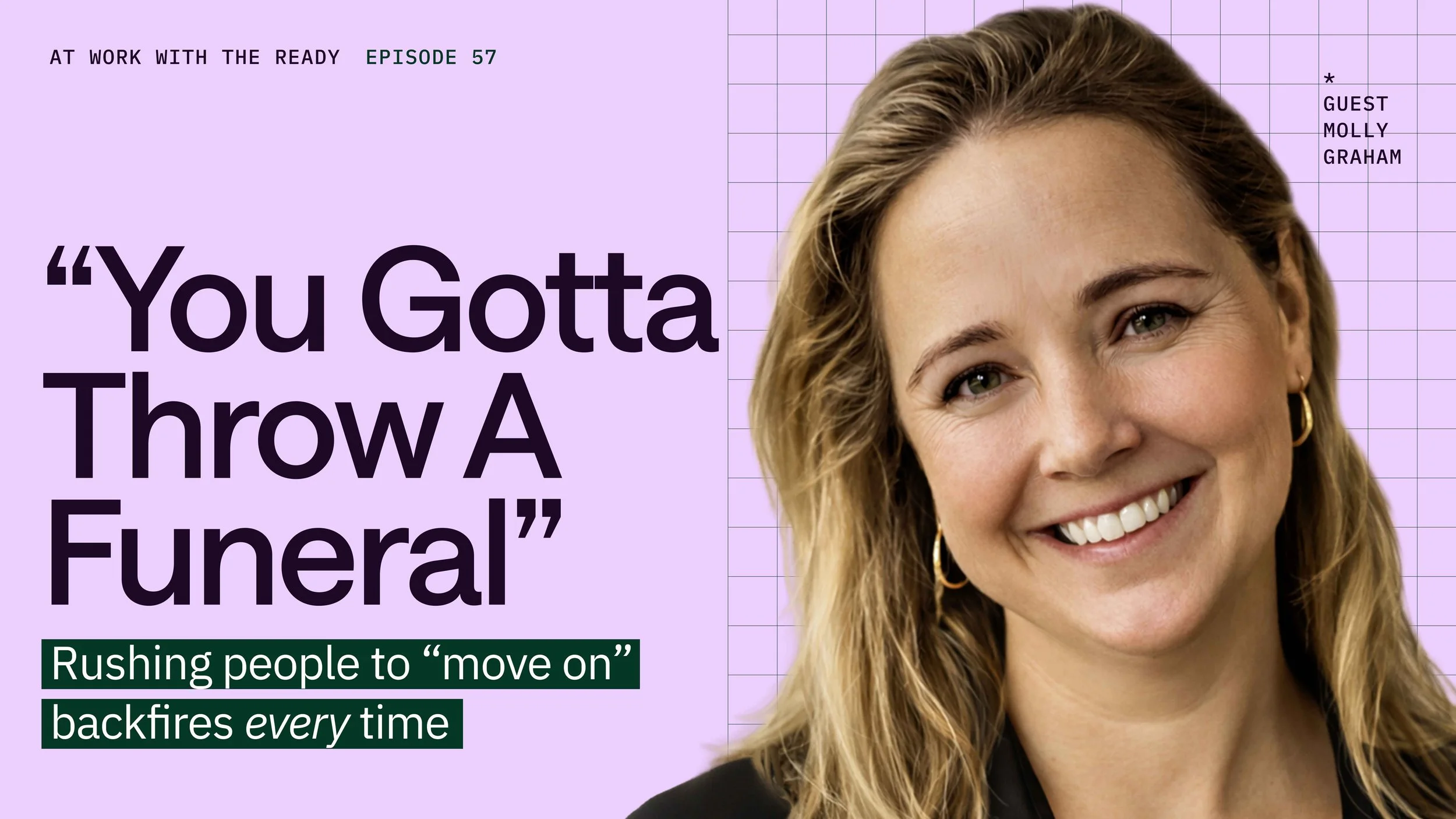
About this episode:
Original Air Date: September 21, 2026Organizations are absorbing more change than they were ever built for, and that change always comes with a lot of feelings. Whether it's a layoff, a reorg, a promotion, or handing off a project you built, we're constantly having to shed hopes and dreams and stability and start over. But most companies are built to avoid those feelings, not process them, so they just accumulate. Leaders skip straight to the "let's get excited about the future!" phase, everyone's feelings go underground, and teams get trapped in a game of pretend that grinds work to a halt.
In this episode, Rodney sits down with Molly Graham, founder of Glue Club and host of TED's WorkLife, to crack open the chestnut of identity, change, and grief at work. They explore the consequences that come with fusing who we are with what we do, the unintentional harm caused by leaders who pretend everything's fine when it's not, and why every big change needs a "funeral" before everyone can finally move forward.
Mentioned in this episode:
In this episode:

Guest: Molly Graham
Founder, Glue Club and Host of WorkLife
Molly Graham is the founder of Glue Club, a community for startup operating leaders, and co-founder of The Guild, a community for senior women leaders. She hosts the WorkLife podcast, part of the TED Audio Collective. Earlier in her career, she lead operations at companies like Facebook, Quip, and the Chan Zuckerberg Initiative. She is perhaps best known for the "Give Away Your Legos" framework on identity shifts leaders face as their organizations scale.
Molly's WebsiteMolly's SubstackWorkLife with Molly GrahamGlue Club
Rodney Evans
Listen now:
Episode transcript:
Molly Graham:
There's nothing more disjointed than somebody doing an all hands that's like, "Everything's awesome now!" And you're like, "Wait...what? We just did a layoff" or whatever.
Rodney Evans:
Right. It's like, "Well, not for me."
Molly Graham:
Yeah. Also, "Are you delusional? Should you be running this company?"
[Intro music]
Rodney Evans:
Hey everyone. This is At Work with The Ready, a podcast about work design and how organizations can make change work in their favor. I am Rodney Evans and I am joined today by the one and only Molly Graham. Hey Molly.
Molly Graham:
Hi, Rodney. How's it going? Thanks for having me.
Rodney Evans:
So good. I'm so glad you're here. Y'all, Molly has spent almost two decades inside of fast growing companies like Facebook, Quip, and the Chan Zuckerberg Initiative, helping them through messy, high stakes moments where every single thing about the organization has to change or evolve. She's also the person behind "Give Away Your Legos", which is a very sharp metaphor for the identity shifts that come with growth and change and maturation as leaders. These days, Molly is focused on building community and sharing her wisdom through the Glue Club and weekly conversations on her podcast, WorkLife with Molly Graham. Molly, welcome to At Work with The Ready.
Molly Graham:
Thanks so much. This is so fun. I'm glad to be here.
Rodney Evans:
Absolutely. I have really been looking forward to this, but before we dig into all of the things, we must check in because we always do. The check-in round question for today is the following: What is a risk that you have taken that everyone thought was a bad idea?
Molly Graham:
It's a custom-made question for me.
Rodney Evans:
Not no, Molly.
Molly Graham:
All of them, literally. I think one of the hallmarks for me of the risks I've taken in my career are basically that everyone that's wiser than me, particularly my dad, told me they were a bad idea and not to do them. The first one I ever took though that viscerally, I remember all these conversations with people being like, "Don't do that," was when I was asked to move from HR and recruiting at Facebook and go work on a mobile phone. It was like this nascent project with no one on it. And even I was like, "Why are we doing that?" I was so excited about what I would get to learn on the project that I sort of felt like I had to do it, but literally my dad was like, "Don't do that. Why would you do that?" Cheryl Sandberg was like, "That project will be dead in a couple of months, but you'll still have a job, so fine, if you want to do it, do it." But most people were not like, "Go do this, Molly."
I do have a friend that said, "You've proven you're good in HR and recruiting. Why don't you go see how actually good you are?" And I've always thought about that as such a good little shove off that cliff.
Rodney Evans:
Oh, I love that. That's amazing. I, similar to you, have a lot of professional risks that people really looked at me sideways about, but I'm going to actually do a personal one, which is I'm not sure everyone though I should marry my husband.
Molly Graham:
That's a good one.
Rodney Evans:
Which is wild because my husband is definitely the MVP of our relationship. When people are the better half, it's obviously him really on every score. But I think that I'm very extroverted and social and he's not. He's a thinker and a sort of a slow burn and more introspective than I am. And I think a lot of people around me that know me really well just were like, "I don't get this. Usually you date people who are carnival barkers because they're like you and the two of you are just like magic. And then now you're with this nerd who's just very kind." And as it turned out, it was a really good decision. We've been together for 20 years and we're very, very happy. But I really do feel like at the time, people who knew me extraordinarily well thought I had lost my mind.
Molly Graham:
Do they admit that to you now?
Rodney Evans:
They do. They're all like, "I should have married someone like Ed." Everyone is like, "I should have married someone like Ed." And they're all correct. They should have. Their husbands suck and my husband's the best. And that's how that goes.
Molly Graham:
Love it!
How to handle the pressure of a big new Lego
Rodney Evans:
Love it. Okay. So the first thing I'm going to ask you about, even though I said I wasn't going to ask you about Legos, is going to be about Legos because, and you don't have to talk a lot about the framework because people have the internet, but I wanted to ask you how it has been being the receiver of a very big Lego this spring for you. You have taken a really popular podcast property over that ran for a long time and had a shape and had an audience and whatever. And I'm curious how that has felt.
Molly Graham:
Yeah, great question. So I got a call about a year and a half ago from TED who owns the podcast WorkLife, which they started eight years ago with Adam Grant and he built it with them for seven years. And it's one of the more well-known work-focused podcasts. And they asked me if I wanted to take it over because Adam wanted to focus on his two other podcasts. And I actually think I said yes on the first call because A, literally the brand of WorkLife and what it's focused on is the work that I do and the work that I love doing, which is really, I think the human side of work and what it feels like to navigate work as a messy, emotional human. And I was terrified. Thinking about it as a Lego, I think it's probably much harder for Adam to give it up because he's built it and it was a big part of his identity for a while, but he obviously made that choice and handed it off very elegantly.
And for me, it was overwhelming and scary and exciting to take it on because I'm not Adam Grant. He's incredibly famous for a very specific set of amazing wisdom in the world. And I'm just a very different person and also come from a very different background. And so I had to spend a bunch of time with Ted making sure that what I was bringing to the table is what they wanted and
Rodney Evans:
Yeah.
Molly Graham:
They wanted to take the show in a different direction, kind of that we were all building the same house to use the Legos metaphor. But for me mostly, the thing that made me say yes was just that terrified feeling because I love being scared. I love being on a learning curve so steep that I'm scared I'm going to fall off it. And that's definitely what doing this has felt like.
Rodney Evans:
That's so interesting. You know it's funny, I didn't think about this before I asked you this, but I have been both the receiver of the Lego in terms of the sort of CEO role. And obviously I don't think of roles as monoliths. And I would tell you, I think being the receiver of the Lego from the top of the house is harder. I've found it much easier to give things away and feel unburdened by them and also excited to see what happens with them than to take them and be like, "Oh fuck, what if I do this wrong or I'm not going to do it the way this person did it because I'm not this person-" I found the pressure of being handed the keys to the Lambo much higher than handing them to someone else.
Molly Graham:
That's interesting. Maybe the lesson is just that they're both really hard. I think there's probably high stakes versions, you know what I mean?
Rodney Evans:
Sure.
Molly Graham:
Which is taking on a CEO title, everyone's staring at you...which is the same as taking on WorkLife. Everyone's like, "Who's this lady? What's she doing here? Who let her in here?" And so I think the higher stakes, the more visibility probably the more you feel the weight of the Lego that you've been handed. But one of the things I've experienced over and over again is that when you build a whole identity around things at work and the process of handing it off is the process of shedding an identity.
Rodney Evans:
For sure.
Molly Graham:
And that brings its own really complicated set of emotions. Sometimes it's just relief where you're like, "Bye." But a lot of times there's grief or loss or fear or all of those things too. So hard on both sides, but I feel you. For sure, this is one of the bigger Legos I've been handed and it's overwhelming.
Rodney Evans:
Yeah. Yeah. Well, congratulations.
Molly Graham:
Thank you.
How your identity gets fused with your job
Rodney Evans:
I think it's amazing. That is a really perfect segue into talking about identity at work, which is something we've talked a lot about on this show. I guess I'm just going to ask you to start by talking a little bit about how you see this. How do people's identities become so very fused with work and why do you think that is kind of the default in at least corporate settings, at least in the US?
Molly Graham:
I bet you have strong opinions about this after all the conversations you've had as well. But it's funny, I did a WorkLife episode recently with this woman who was the former CEO of TaskRabbit, and it was actually on faith at work because she comes from a faith background. And we were talking about this. We were talking about the difference between when you get your purpose or your sense of meaning from things outside of work, and in her case not necessarily on this eart,h versus when people's identities do get fused with work. And I asked her, somebody had said to me that it feels like as organized religion has become less of a dominant thing, that people are actually throwing more of their being and their identity into work. And what does that mean and why is that?
I see it in all my friends, all the leaders I work with, all the folks that I've coached and mentored over the years. As folks search for meaning and they think about what am I doing with this life, I think a lot of folks pour that into work. And before you have kids, before you have a family, if you don't have outside forces like religion or other things like that, I think it can be a really powerful source of who am I, what am I great at, and what is the sort of thing that I was put on this earth to do?
And that's so awesome. It can be such a grounding force in people's lives, and I think it can become very problematic and complicated and sometimes toxic. And I think everybody at some point hits a wall where you have to ask, what is my relationship to success at work and is it healthy and all of those things. But I think there is both great and bad things with how fused people's identities have become, particularly in the US with work and productivity and success.
Rodney Evans:
Yeah. It's really interesting. I'm not sure I see an upside.
Molly Graham:
Explain.
Rodney Evans:
Well, I think that anytime there's fusion with an identity, whether it's like I am a CEO or I am a mother or I am a whatever, I feel like not having any distance between I am a whole person and also I do this thing, I don't think it's great. I think it becomes then difficult to make choices with our wholeness in mind when we are operating from a fused position.
And I think we see this a lot in the political landscape right now is people feel like I am this party or I am this subset of this party. And I think it can be very calcifying in terms of people's ability to be psychologically flexible. And even I'll have conversations with friends of mine at work around something like title and they're like, "Well, I am currently the COO." And I'm like, "Yes, but you are first of all a human and second of all, you fucking hate your job. So who cares? Go be something else." I just think it can be, I think a little distance between who we are as people and these various sort of roles we play or hats we wear, I think is psychologically beneficial.
Identity shifts across a career
Molly Graham:
Yeah. It's so interesting. It's like one of the questions that I have been really grappling with as I've gone. Well, I think in general, but then WorkLife has been an incredible platform to explore it. Because I think when I reflect on my own journey, I feel like I had this phase that was a proving phase of my career where I was really bent on proving that I, I guess deserve to be there and proving what I was good at. And I think when you look at folks in their careers, there is this sort of showing up on the scene that has to happen in your 20s. "Who am I at work? What is my relationship to work? What do I love? What do I hate? What am I good at? What am I bad at?" But I fundamentally agree with you that I think investing your whole identity and success at work ends up falling apart at some point. It ends up biting you in the ass in one way or another if that's your whole being.
And I had a conversation a couple of months ago with a guy who is very well known. He built a really successful company that everyone admired, ended up selling it for bajillions of dollars, and then immediately became crazy depressed and then has gone on this journey since then to try to understand the forces that caused all that to happen. And the interesting thing was that he told me this story about somebody, Ted Turner, had basically sat him down at some point and it was sort of like a passing conversation. He had said to him, "Hey, I just want you to know you're climbing a mountain right now and I think you are going to get to the top of that mountain. Not everyone gets to the top of the mountain. I see you as someone that's going to get there." And he was like, "I want you to know at the top of that mountain, there's going to be a gold chest and you're going to get to the top of mountain, you're going to open the gold chest and it's going to be empty."
And he told this guy this story when this person was kind of at the beginning of their journey. And I was like, "Wait a minute, somebody told you when you were early that literally what was going to happen happened."
Rodney Evans:
He warned you.
Molly Graham:
"He warned you!" But it's caused me to ask this question, which is the sort of inevitability of this struggle versus can the right advice in the right way at the right time unlock things for you? So I do think in American society there is something very entangled about folks pursuing success and that feeling like a really big north star for a lot of people. And I think it's both powerful in the sense that it's obviously built some incredible companies and things like that and so toxic in the sense that it ultimately can eat people alive. And one of my questions is, "Okay, what do we do about that? What do we do?"
How capitalism anchors your personal life to your work life
Rodney Evans:
Yeah. I mean, it is the question, right? And without taking us on a side tangent, I am on a side quest for one quarter exploring an adjacent thing that I haven't talked yet about on this show. And I won't today, it's coming. But through this line of study, one of the things that I've been really investigating is the role that work plays in other societies besides late stage capitalism.
Molly Graham:
Cool.
Rodney Evans:
And in a lot of countries, particularly countries that are democratic socialism, and that's the structure of government, there is this tremendous amount of scaffolding provided by the nation. And a lot of the responsibilities of the country are in the US outsourced to the individual. And companies in the US play a role that they don't play in other places because our healthcare is tied to our companies, our retirement is tied to our companies, our ability to buy a house is tied to... I don't think companies should be responsible actually for the physical wellbeing of their employees, but a woman giving birth does so at her company's discretion, basically.
And I think it's hard to totally disaggregate these conversations. It's like when the thing that provides you with basic living standards is your employer, how do you not become fused? How do you not overinvest? How do you not become anxious about losing that when you have no other way to get it here?
Molly Graham:
Yeah. Yeah, that's super interesting. I think it'll be a great podcast. And I think there's so much in that too, because it's like who are the icons that a society holds up that everyone's supposed to aspire to? All of those things when you look at them in the US, it's all about obviously independence and you can make it the American dream, all of that stuff, but it ends up manifesting in success in business.
And so I think there is something societal at a fundamental level that the message is coming again and again, this is where you should get a lot of your sense of self and your sense of identity. And I think for every single person that does come crashing down at some point, whether it's getting fired or laid off or just realizing that you get... I have a friend that always tells this story where she's like, "Yeah, I climbed this ladder. I became CEO. I got to the top and I was like, 'Is this all there is?'" You know what I mean? This is it. And so everybody has some moment where they just hit the wall and they're like, "Uh-oh, this isn't the whole thing. So what else is there?"
Rodney Evans:
Yeah. I always joke that my experience of being a CEO is a pie eating contest where the prize is more pie.
Molly Graham:
Totally.
Rodney Evans:
And it's just like, "Sick. I would love to not have pie today." Yeah. So I think this is a thing that I've been thinking about because I think it's so hard to disaggregate identity fusion and ambition from capitalist structure that basically says "If you don't hustle and if you don't perform and if you don't ascend, you won't be able to take care of your parents and your children and your health and all of these other things because that's the only way to do it here." Wnless you're born wealthy. If you're not already born with stability baked in, the only way to do it is to ascend. And so it's like you can hardly blame people.
Molly Graham:
Yeah, totally. No, I mean, I think one of the fundamental things I always reprobe in all of my work and certainly in WorkLife is why do we have jobs? There's the Maslow's hierarchy of needs. You have to be able to take care of your family. You have to be able to feel safe and your basic needs are met. And then on top of that, I think there is obviously meaning and purpose that people find, but you can't really focus on meaning and purpose if you're scared that you can't feed your family or your cat.
Rodney Evans:
Yeah, 100%. Or that now that there is so much churn at every level of organizations, it's like, is the stability going to be lasting or are you going to be caught up in the next riff or the next executive placement or board churn or whatever? It's like things are much less certain than they were even when I entered the workforce 25 years ago.
The fear-driven meta-narrative around AI
Molly Graham:
Yeah, absolutely. It's one of my biggest frustrations right now, honestly, is that I think there's a meta-narrative around that's causing just abundance of fear. And some of it is real for sure. It's a kind of employer driven market that we haven't seen in a really long time and also no end in sight. But some of it is bullshit. Some of it is people blaming business-based layoffs on AI.
Rodney Evans:
Which is just...the data's just not there.
Molly Graham:
Maddening, maddening. Well, it's maddening to me because it basically reinforces this culture of fear. The robots are coming for your jobs and no one's going to have a job in a year or something like that. And it's like, that's not real. But it is terrifying the stories that are out there paired with, again, obviously a contraction in a lot of different companies and sectors that have previously been growing and growing and growing like tech. But I think that fear is so problematic because it traps people, it takes away curiosity and joy and exploration. If you're terrified, you don't want to do any of that. You know what I mean? You just want to hold onto your job for dear life.
Rodney Evans:
Right. Absolutely. I think the thing that makes me just annoyed about the AI narrative about job loss also is that I'm like, this game of extraction within companies and efficiency at all costs and running on fumes and just completely outrageous executive compensation packages, that's much more the story under these layoffs. And it has been, but it's been growing particularly as there's been less and less regulation, et cetera. I'm like, there is a circular economy of billionaires.That's where the money's going, you guys. Don't worry about AI right now. That's a good headline and it bumps the stock price, but that's not really what's happening here. The headcount freeze and the hours cut and the travel ban, et cetera, that has nothing to do with AI. That has something to do with someone's compensation package that they want to get this year.
Molly Graham:
Yeah. I mean, I think that thing you said of just it's a great story that leads to a stock price bump is the thing that drives me nuts, which is I understand the incentives at the top of organizations and it's really damaging for the average person to be hearing over and over again AI is coming for you. Not the least of which, it's actually an incredibly powerful tool that people need to be deeply investing in and exploring from a place of creativity and curiosity and joy. And nobody wants to do that when somebody's like... It's like hiring an employee and being like, "Can you onboard them and tell them everything you know and work collaboratively with them and they're definitely going to take your job in six months and you won't have one?" Like nobody wants to do that. You know what I mean? Yeah.
Rodney Evans:
Of course. And also just back to the narrative, it's like what executive isn't going to say that when it just makes you look strategic instead of greedy? Like, of course.
Molly Graham:
Yeah. Or futuristic instead of like, "Whoops, I ran my company too heavy for the last five years and I need to do this layoff because we do have too many people, but it has nothing to do with AI."
Rodney Evans:
"We are super bloated." Yeah, I love that.
I want to hear more about your take on AI. My co - CEO sent me a few things that you had said that I was like, she's really smart about this because these are very practical tips. First of all, hard plus one on asking people to engage with what they essentially see as a professional trained killer sitting next to them.
Molly Graham:
Dude. It's maddening.
Rodney Evans:
It's not the way. It's not the way.
Molly Graham:
It's not the conversation we should be having.
How we should actually be talking about AI at work
Rodney Evans:
Not the conversation. What is the conversation? How do you think employers should be talking to people and how should we be talking to each other about using AI at work?
Molly Graham:
So let me just talk about the meta narrative that drives me nuts for a second and then I'll get into the what do I think we should be talking about. So to me, the meta narrative, obviously there's this AI's coming for your job, right? But the other meta narrative that drives me a little nuts is AI is this super intelligent, "better at everything than you", PhD with 25 years of experience that just showed up. So it's brilliant. I actually think that is hugely problematic because actually when you work with AI, it's a lot more similar to a really mediocre summer intern. Do you know what I mean?
Rodney Evans:
I was just going to say, I feel like it's a very fast but sloppy intern.
Molly Graham:
Highly confident, which is the other thing. It's like fast, highly confident. "Look at this perfect thing that I made." And then you look at it and you're like, "Wait, what?" It's like being handed the intern presentation where you had five meetings with them ahead of time and you were like, "Here's all the context and everything from my brain." And then they hand you back this presentation and you're like, "This reflects none of the things we talked about."
Rodney Evans:
Yes, absolutely.
Molly Graham:
That is actually most people's experience of working with AI, but because there's this narrative that it's super intelligent and smarter than you and better than you at everything and prettier than you, you sort of get this confident work from this intern and you're like, "Okay, I'm just going to forward it to my boss." And that's where AI slop comes from. You know what I mean? Yes, it's rotting our brains in various ways, but actually to me, the harder thing is that we're not talking about it in the right way in terms of what is it actually.
And I've done a couple episodes on WorkLife just because I feel stupid about AI. I think everybody does. I don't think anybody actually knows what's going on. So I was like, "I just want to go talk to people that are deep on the frontier of this." And every single one of them has basically just said, "AI is a tool. You need to think of it like Excel or the calculator or spell check. It is a tool that enables you to do things, but at the end of the day, that doesn't change that much about work. And I think part of the problem is that people have sort of been like," Oh, it's like a person. It's like a new hire that is smarter than me, and so I'm going to trust it and outsource all my thinking to it and all this stuff." And so you need to work with AI as if it's a lazy intern, meaning you need to be really giving it context, training it, coaching it.
But then I think secondarily, it kind of turns us into lazy interns because we're like," Oh yeah, I'm just going to not read that presentation and made and just forward it on, "which is lazy. So for me, the most important thing is number one, people need to still be held accountable for the work that they send regardless of how they made it. That's always been true. You use spell check to edit your spelling, you still own the document. The second is, and this has been really helpful to our team and to other leaders that we work with in our communities, is show your work just like you did in math class. Say how you made something like," Hey, I did this and then I used AI to do this," because that helps people interpret it. It helps people read it in a certain way. And then the third is just work with AI like it's a lazy intern. You know what I mean? Don't work with it as some super intelligent being that's coming for you. Work with it as a tool because that's fundamentally what it is.
Rodney Evans:
So as I'm on this little side quest, because I don't have to deal with sensitive client information, I've really been able to do whatever I want with AI, which has been very freeing. And to your point about the lazy intern, my general approach has been, I'm going to make it do everything I don't like.
Molly Graham:
Yeah, totally.
Rodney Evans:
Which is what you do with an intern. I've had interns.
Molly Graham:
Totally.
Rodney Evans:
That's what they're there for. That's what I did as an intern. And it's been a really fun, non-threatening, and quite productive way of partnering to be like, "I don't like doing meeting prep. What if I made an agent that sweeps my calendar and does this?" That's fun. I'm not worried that that's job taking for me.
Molly Graham:
Yeah, totally. I mean, I think to me, so lazy intern rants aside, I would say the opportunity of the future is to think what is the highest and best use of humans if we have this magical, powerful, somewhat dumb learning tool to do rote work, to do things that are repetitive, to do things that require immense amounts of research and access to information. So I love your, how do I think of everything I hate doing and can it be automated? The thing that bothers me about the fear narrative is that it sort of kills the curiosity and the exploration. And I think that's actually the attitude that you need when you're thinking about how do I integrate AI into my work? Because it should be about, "Ooh, what could this look like? Ooh, that's fun. Ooh, that didn't work. How about I try it again or try it differently or explore something else?" But it's hard to be in that exploratory mindset and that curiosity mindset when you're terrified.
Rodney Evans:
Yeah. It's interesting because there is sort of the grunt work side of it, which I think I've gotten quite good at it. And then there is also, when you said the thing about research and large data sets, et cetera, I am so thoroughly delighted by the ability to have a combination of a transcript and a 30-page deck that someone has sent me and six articles and two podcasts and a rambling voice note from my car and be like, "Pull out the 10 least obvious, most provocative insights from all of this." My brain is never going to be able to do that. I enjoy things like that, but it's way more fun to start from the 10 insights and then be like, "Okay, this is a four out of 10. Now I can really engage with this to make this be a 10 out of 10." I think to your point, people are kind of flooded by the threat of it and then unable to have fun or get rid of boring shit that they don't want to do.
Molly Graham:
Yeah, totally. And to me, you started this by asking what would you do if you were running a company to get people to lean in? And that is the question, which is how do you get people to look at this as joyful and as an opportunity and as a playground, not as a threat? And it does start with changing the narrative, at least inside your own company. But I think holding up exploration and success and failure about what we've tried and what we've learned seems to be one of the most common ways that's really made a difference inside of companies is just how do you make it playful? How do you make that part of people's jobs and lives to mess around with this stuff and figure out how it can make your life better and what the right relationship is to it?
Rodney Evans:
Yeah. And in so many organizations, there is a profound problem. There's a profound dysfunction in most organizations, which is that highly paid people are too busy to think. They're just doing work around the work all day long in pointless meetings that are status telegraphing, just moving pixels. And I feel like the drumbeat of my last 10 years of doing this work in organizations is leaders being like, we don't have enough time and space to think big thoughts and have big conversations and be forward looking. And I'm like, well, now you do. Now you do, so go think. But I think that muscle is so underdeveloped that it actually feels more comfortable to keep your day full of garbage than to have this spaciousness and do something that feels ultimately more satisfying, but initially a lot less familiar.
Molly Graham:
Yeah, it's like an underdeveloped muscle. The other thing, I'm sure you've seen this as well, is one of the trends that I think is not a great thing is we see a lot of CEOs outsourcing the big thinking to the robots.
Rodney Evans:
Oh, interesting.
Molly Graham:
Where you get the strategy memo and you're like, "...You didn't write this." And I think that's a mistake. Do you know what I mean? I think it's obviously, I feel like Claude and GPT and Gemini are great brainstorming
Rodney Evans:
Partners. Great partners,
Molly Graham:
But there's a huge difference between brainstorming and going back and forth and using it to advance your own thinking, build that muscle to your point and being like, here's the inputs, what should our Q3 strategy be? And then copy, paste, ship, which happens. And it's nuts. You're like, what does that tell everyone that's working for you about what work should look like? What work product is good? That's not ideal.
Rodney Evans:
And also, what does that tell your workforce about what the point of having a CEO is?
Molly Graham:
So real.
Rodney Evans:
I mean, it's not great. It's not great.
Molly Graham:
Well said. Well said. First job to go.
Why we’re so bad at handling feelings and grief at work
Rodney Evans:
One of the things sort of along those lines that I wanted to ask you about is this idea of grief at work. And I do think people right now, obviously there's a lot of job loss. Obviously the job market has never been less navigable. I mean, I feel like what a phenomenal hellscape that whole situation is. And I feel like there is both profound grief for the fact that most people are not going to experience the kind of careers that we had from when we started. And I also think there's a lot of anticipatory grief that people are feeling because they know that things are changing and they feel uncertainty about how. How do you think about grief at work? What role does it play? Should it play? Should we talk about it? Should we pretend it's not happening? Talk to me about grief, because I think in general, we're bad at it.
Molly Graham:
I mean, we're super bad at it in all aspects of life. I don't know how you get good at it because it's one of the worst things.
Rodney Evans:
It sucks so bad.
Molly Graham:
Yeah, when you lose something fundamental. And I think obviously there's been a lot written about grief from loss of a life or a loved one. And I think that what really hit me like a truck was realizing that all the things we talk about in terms of losing a loved one or losing something very important to you happens at work. It happened for me when, it's actually when I ran my first layoff. I experienced the whole thing that happened after the layoff as an entire organization grieving. And I wasn't prepared for that as a leader. I sort of showed up the day after the layoff thinking, okay, "My job is to inspire and motivate and get people excited about the future" and it was stupid. It's like, no, people need to grieve. You just literally killed the organization as it existed before and they need some time and space to mourn that and then move forward. People can only move forward when they've gone through their processing period.
And it made me reflect back on so many different experiences I'd had at work, including good things. I think there's grief when you get promoted to manage a team. You get promoted above your peers. You get a new job. There's grief in leaving something and having to forge a new identity. There's also a lot of grief in giving things away, in having to build a whole identity and then shed it when it's time to move on. So I feel like it's everywhere once you start realizing it, but we don't talk about it enough at work. It's not a conversation. And it is so much healthier, to use the very crystallizing layoff example, you got to throw a funeral. Do you know what I mean? You got to actually embrace it as part of the process and think about how do I help people who are genuinely grieving feel their feelings? What do they need? They're going to be angry, they're going to bargain, all those stages that are true in all forms of grief.
And I think as a leader, if you accept that it's part of change, again, even good change, then you can actually think, "Okay, how do I help someone through this process?" Maybe they just need time because that's grief. Time is the greatest healer. Obviously it doesn't always heal all grief, but maybe they actually need a space to be angry or whatever versus trying to sweep it under the rug, which is often what we do at work when it comes to feelings.
Rodney Evans:
Yeah, I think it's really true. And I think it's especially true with this particular feeling. I've had the experience with several leaders, and candidly, I've been this person too, where as you well know, the lead up to a layoff is pretty agonizing when you're making the decisions. It's not a fun season. And I was in HR at an investment bank during the financial crisis. I laid off hundreds and hundreds of people and then have done so in other contexts as well. And so I'm sure you'll recognize that on the one hand, it is a fairly unpleasant season of work. And also, I was always trying to be like, I am not going to center myself in this because I'm not losing my job. And this person sitting in front of me is having their world turned upside down. It's not really about me.
And therefore, when it was over, I definitely was like, "Can we not? I'm good now. I got through this painful marathon. I don't really want to talk about this anymore." And that for many people is just the starting point because they are consuming this change for the first time that I have been architecting for months. And I think this is a place where there's a disconnect between the people doing the layoff and the people impacted either directly or because their friends and peers are let go, where a lot of times the leaders are like, "I don't want to think about this anymore. I don't want to be in this space anymore. I'm so relieved that this is finally over. I'm ready to move on because I've already had time to process." And I often feel like a lot of CEOs, particularly that I know, feel like they're being questioned about whether it was the right decision and how they made it and all of these other things that are destabilizing for them.
And so there's all these reasons that the people who should be holding the space don't, and the people who need the space held don't have it. And then I always joke when I go into a company after a layoff and nobody's talked about it and I'm like, you guys are living in a haunted house. The ghosts are everywhere and they are going to continue to haunt you if you ignore them. They're not going away, you guys.
Molly Graham:
Absolutely. And I think for me, what I say to leaders is you did your grieving.
Rodney Evans:
That's right.
Molly Graham:
I think any leader that has a heart goes through a grieving process while you are planning the layoff. Oftentimes it's in the process of accepting that you have to do this, right?
Rodney Evans:
Yes.
Molly Graham:
I know for me it was a multi-week period of just being really angry. And then you get to a place where you're like, okay, time to move forward. And then you begin the planning. But as you said, when you announce to everyone, "Hey, this is happening," that's when it starts for everybody else. So I see this a lot with CEOs that I've worked with in the past where they're like, you get to the layoff and then you're sort of impatient for people to move on. It's the same with a reorg. We reorganized everybody and you're like, get excited. And they're like, "...but I'm sad."
And so I think to me, when you do these big change events, you just really have to design grief into the process of how are we going to help people hold it? What space do we need to make for it? But even if you don't want to create a whole thing around it, it's just time and space before you get all fluffy bunny and let's get excited about the future with people. They need time to process the change, whatever form it takes. And I feel like that's not something a lot of times, again, we want to rush, we want to push people into the future.
And that's to your point, I love the haunted house. That's such a good metaphor because it's basically a game of pretend, you know what I mean? Let's pretend everything's great and fine. And everyone's like, I'm having so much fun on this. Yeah. It's like, no, you need to be like, I'm sad and I'm having a hard time and I'm angry and I wish there had been a different way. Didn't you think of other options or whatever? And only when they've gone through all of that can they actually figure out how to productively move forward.
Moving leaders from “shit umbrella” to “shit filter”
Rodney Evans:
Totally. And I have had this feeling, is there any worse feeling than someone with more power than you being like, "Let's get psyched!" when you're like, "I was just crying in the bathroom...so no." That's going to be a no from me dog at this town hall.
Molly Graham:
Well, it just makes you judge the shit out of them, you know what I mean?
Rodney Evans:
Well, that's also true.
Molly Graham:
I say this to the leaders in our community and workshops and stuff all the time. It's like we always say our job as leaders is to be a shit umbrella, that you're supposed to protect people. And I think sometimes we take that mandate as I will make it fine for them. I will make everything okay. And I'm like, dudes, sometimes it actually just needs to rain shit. Do you know what I mean? Sometimes people just need to be like, we're covered in shit. Because then they're contrary to sometimes how it feels, everyone's an adult here. You know what I mean? I just want to know what the fuck is going on. I don't want you to pretend like everything's rainbows and bunnies and fairy tales if it's not. I want you to tell me how to understand everything that's happening. And there's nothing more disjointed than somebody doing an all hands that's like, "Everything's awesome now!" And you're like, "Wait, what? We just did a layoff" or whatever.
Rodney Evans:
Right. It's like, well, not for me.
Molly Graham:
Yeah. Also, "Are you delusional? Should you be running this company?!?"
Rodney Evans:
It's so true. And I love your point about the shit umbrella because that is one of the things that always to me, and I got that advice from mentors as I was getting promoted and getting teams. That advice always felt weirdly paternalistic to me in a way where I was like, "These people don't need 'protection.' They're grown ass adults. They need protection from the financials. Why?" People should have all of the information so they can make decisions that impact their lives. It is not my job to be the PR spin team of the mistake this leadership team just made or the bad news or whatever. It's like tell people the truth and they're going to interpret it through their own lens no matter what you say probably.
Molly Graham:
Yeah. I mean, I think a shit filter is a good thing because we've all worked for the CEO or someone that's got a new idea every 13 seconds and 85% of them are not useful. So I think there is a set of thrash. We don't bring everyone on a fundraising journey because there's so many no's and the nos make you super depressed and we don't need the whole company going through that.
There is protection that is positive because it's like, you don't need this noise. But I think that it's the overprotection. It's like the perfect sealant of a bubble that comes with the concept of an umbrella that I think is actually works against managers sometimes because I'm like, no, if things are uncertain and there's a lot of change and maybe some stuff is bad, you're not supposed to lie to people. You're supposed to be like, "Hey, here's what I know and here's what I don't know. And our CEO's a little crazy and he has a lot of bad ideas, but he's got a couple good ones." So I mean, you want people to understand reality. And that to me is more of a filter than an umbrella.
Rodney Evans:
Yeah. I love that because I think what you're talking about is protecting people from unnecessary distraction, not protecting people from the truth that impacts their lives.
Molly Graham:
Exactly. Yeah. I'm not trying to pretend something is different than it is.
Rodney Evans:
Not making things up.
Molly Graham:
Yeah, exactly.
Why grief doesn’t care about your deadlines
Rodney Evans:
That's really cool. I love that. The other thing I was thinking about grief that I've thought a lot about is I think grief is kind of like the opposite of productivity. And I feel like that's one of the reasons that we're so allergic to it at work. It's like it's not linear. It can be very all consuming. A lot of grief is not active. A lot of grief is just sitting there while a wave crashes over you and you try not to drown. It's not a thing that you can be like, "On Friday, I'm going to be done with this and I'm going to crush my goals." In most organizations, there's not a space for anything that's like that, for anything that's sort of amorphous and messy and different by person and different by situation. It's very hard to design for that, and I don't think we're very good at it.
Molly Graham:
No, I agree with you.
Rodney Evans:
We're a little bit like, "Will you be done grieving by Tuesday though because we do have that all hands?"
Molly Graham:
"Here's your timeline." Yeah, no, I agree with that.
I mean, I think that's true of a lot of human things at work. To me, grief is just one example of feelings at work. And to me, all forms of change come with a lot of feelings. And I think both individually and then also as a manager and leader, you're kind of just like, "Just tough it out, get through it and it'll be fine." And I think that's usually not the most productive way. You wouldn't do that in most other parts of your life, force your way through something that needs a good wallow. But I don't think work is well designed to handle all of that humanness. It's part of why I was so excited to have some of these conversations on WorkLife and a lot of the writing I do is just to normalize that.
Really, when I published the Legos article, it's a very long article, so people are like, "Can you summarize it for me?" And I'm always like, "I swear to God, all that the Legos article did was just say, don't worry, it's going to be okay. Other people have gone through this too." Which sometimes is all that people need to hear. When I go do speeches at companies, I laugh that they're like group therapy because I feel like everyone's sitting there, whether it's high growth or transformation or whatever, just being like, "Everything is okay." And I'm like, "No, you're having a hard time. It's up and down. You've got all these feelings and emotions and it's going to be okay.That is normal." And that causes this like, "Oh, okay. I'm not crazy. I'm not alone. I'm not the only person in the world that's ever gone through this." And to me, sometimes
You don't always need to give people weeks or months to wallow in something or whatever. It's more just about saying, "Hey, these things might be happening and that's okay." And normalize it and name it and make space for it.That was actually why I wrote the Legos article in the first place was because I kept having to have this conversation with people on my team where it was like, "Hey, this person's being hired. You're going to have to hand them half your job. It's going to feel like this. You might have any of the falling emotions during this time, and there's lots of good stuff coming for you, but it's okay to feel all these feelings." And it sort of ended up in an article that took off and traveled, but that was all that it was, was just naming it and normalizing it, which I think is something we can do as leaders while still being like, "And we need to ship that thing on Wednesday."
Rodney Evans:
"And we got to make our quarter."
Molly Graham:
Yeah,
What responsibility do companies have for worker wellbeing?
Rodney Evans:
Exactly. I think this brings me to the last thing that I wanted to ask you about, Molly, which probably could be a very long conversation. We won't make it be so, but I appreciate that a lot of your work centers on normalizing emotions, naming emotions, making space for humans to be our messy, behaving selves, et cetera. And I also wonder how much of that is kind of coping technology to work inside of systems that are in many cases responsible for producing those feelings or at least...I mean, I would argue that most scaled organizations in America produce more anxiety and burnout than they make of whatever they're selling. That's what companies in America are designed to do is make people anxious, which is great for pharma, but not great for human thriving.
I wonder how much responsibility do you think organizations have to design systems where people have enough safety, enough resource, enough guidance, enough predictability, enough time off, et cetera, that maybe they're not total basket cases?
Molly Graham:
Yeah. I mean, I'll tell you the things I wish and then there's - Tell me what you wish. The realities. I mean, what I wish is that the incentives of organizations naturally led in that direction. I think that for me, it goes back to that first conversation we were having around success and success addiction and your work being married to your identity. In theory, that can be a great thing. In theory, that can lead to ambition and really cool things being built in the world. And it obviously then can turn on people. It can destroy the person that holds it. And so I wish that organizations had a lot of incentives to build spaces for people to rest and to take time off and to take care of themselves as much as they do to be productive.
And I don't know what that looks like, but one of the things I do really firmly believe is incentives are the most powerful thing in the world. And the way organizations work is they're there to deliver on results and they're there to build whatever business they've decided to build and they're going to focus on those objectives above everything else. And I always say organizations are fundamentally selfish. They're going to do what's right for them. You have to learn how to get what's right for you. And that means they're not going to always tell you to rest. They're not going to make the space for you. They may give you the vacation, but do they let you take it? Or it's not even like you take -
Rodney Evans:
Or do they hold it against you?
Molly Graham:
Yeah, exactly. Or do they make it hard?
Rodney Evans:
Right.
Molly Graham:
I feel like a lot of times burnout and all the things around that, like work-life balance or flexibility or whatever you want to think, it's half the organization and it's half you. And so I'm always like, "Is it an organization that supports and makes space for people to rest and have lives? And then do you make that space for yourself?" And I've witnessed people in very supportive boundaried organizations working 20 hours a day. So it is a two-sided coin.
But for me, the only thing I can see to invest in inside this capitalist society that is the worst form except for all the other ones, is to try to build leaders that understand how to build organizations that can handle the human sides of work as much as they can handle the output and the productivity. And that, for a bunch of different reasons, is not the average founder or CEO that is being built in this society.
Rodney Evans:
Those are not people who get promoted, Molly.
Molly Graham:
I mean, I think they do, but it doesn't mean they naturally know how to do it. Do you know what I mean? I think it takes skill and energy to think, how do I create clarity for people? How do I create boundaries for people? How do I support people in a way that means they'll be here in five years, not just the next six months? That is a mature form of leadership.
Why the worker-employer contract is breaking down
Molly Graham:
But I hear you. I think it feels very extractive right now and it feels very one-sided. And I think there's healthy things about that because at least where I was raised in the technology industry was always like, "Pour your heart and soul into this thing and you'll make a bunch of money." That was always the message. So people poured their heart and soul into that and sometimes they made money, but a lot of times they didn't. But it felt like a two-sided relationship. It felt like "I'm going to get something out of this." And now I think it feels very like you show up at work and we beat the shit out of you and then we pay you a salary that's really small and we ship you back to a really expensive life. And that feels like something's really going to break in that relationship at some point. I don't know what that's going to look like, but I hear you.
Rodney Evans:
Will you say a little bit more about that? What do you sense is coming or what makes you say you feel like it's going to break? I have the same sense, but I don't know that I could articulate exactly why I believe that that is on the horizon and I think it's in the next few years.
Molly Graham:
I don't know. I mean, for me, in the technology industry, which is again where I've spent the last 20 years, I've watched it flip back and forth in a healthy way between an employer driven market, meaning employers can set the salaries and the benefits because there's a lot of supply. There's a lot of supply of engineers or a lot of supply of workers to an employee driven market where employers are desperate for talent and the salaries go through the roof. I once lost in the crypto boom, I lost an employee to a $70,000 raise and I was like, "Okay, power to you." I was like, "Get out of here."
Rodney Evans:
Go get that bag!
Molly Graham:
I've seen both sides and it's always flipped back and forth on two to five year time horizons. And something happened in 2021 when crypto exploded and it was the tail end of COVID and then AI showed up almost at the same time a year later where I was like, "Ooh, I don't see this flipping back. I don't see it flipping back to an employee driven market because the conversation is suddenly about efficiency and the vanity metric is no longer how many employees we have and stuff like that, which used to be the conversation in tech a lot. And so that to me is the thing I stare at and I'm like," That means that employers have this incredible power where there's too much supply and so they can pick and choose. And that means the interview cycles can be 10 months long or whatever, abusive interview cycles all the way to how they treat employees and what they demand of people.
And that, again, fear narrative that we've been talking about combined with, and again, you've mentioned this, everything is so expensive and inflation is so crazy and does not seem to be turning around and people can't afford mortgages or houses. And I'm just like, how does this not end up with something? And I don't know what that is, but there's nothing healthy about it. I will say I think there's going to be opportunity that comes out of this too. I think more jobs will be created than we imagine. And I hope that maybe what I'm wrong about is that it will flip back to an employee driven market in some form, but I don't see exactly when that's going to happen or how.
Rodney Evans:
We shall see. I don't know. I suspect that it will follow what happens politically. I think right now everything has really shifted to dominance, command-and-control, extraction, wealth hoarding, et cetera, and it's turtles all the way down. I think when that pendulum swings, and I think we're starting to see that in pockets with people getting elected that 12 months ago would've been unelectable because of messaging that is around workers and fairness and working conditions and things like this. I sort of suspect that the backdrop needs to change because right now the celebrated behavior is extraction to the extreme. And I had a really interesting conversation with CEO yesterday related to my side quest, and he was like, "You know, Rodney, the problem with the CEOs right now in most cases in America is none of them know what enough is."
Molly Graham:
That's a very interesting sentence.
Rodney Evans:
And I think it's related to what we're talking about when more is 'better' and growth is baseline and just hyper growth is sort of the only metric that matters, whether you're talking about personal wealth creation or organizational upside, I think it's very difficult to create the kind of experience at work that you and I are talking about because where's the slack for it?
Molly Graham:
Yeah.
Rodney Evans:
Where's the slack for it?
Molly Graham:
Or the incentive, you know what I mean?
Rodney Evans:
Or the incentive.
Molly Graham:
I find it very confusing as to how it changes. I wish I was a believer in politics. Unfortunately, I grew up in Washington DC, so I believe in general forward progress, but I always worry about just it goes red to blue to red. But I think the main thing I violently agree with is something has to change.
Rodney Evans:
Something has to change.
Molly Graham:
And it feels like it will. I think I just don't totally understand where it's going to come from.
Rodney Evans:
I don't think anybody does, really. It's all just guesses.
Molly Graham:
We're both going to find out.
Rodney Evans:
Yeah, we're going to find out. Okay. Molly, that seems like a pretty good place for us to close up here. Where can our listeners learn more about you and your work?
Molly Graham:
So I spend a lot of time writing and thinking both on LinkedIn and Substack, so those are probably the two places I would go look for.
Rodney Evans:
Alright, you guys, go follow Molly. And for our listeners, we are always looking for new topics for the show. So if you have an organizational pattern that you're having trouble changing, shoot us a note at podcast [at] theready [dot] com. This show was edited and mixed by Taylor Marvin at Coupe Studios and produced by the wonderful Jack Van Amburg. At Work with The Ready is created by The Ready where we help organizations around the world change the way they work. Thank you for listening.