
AUA: How to Get Institutional Knowledge Out of People’s Heads
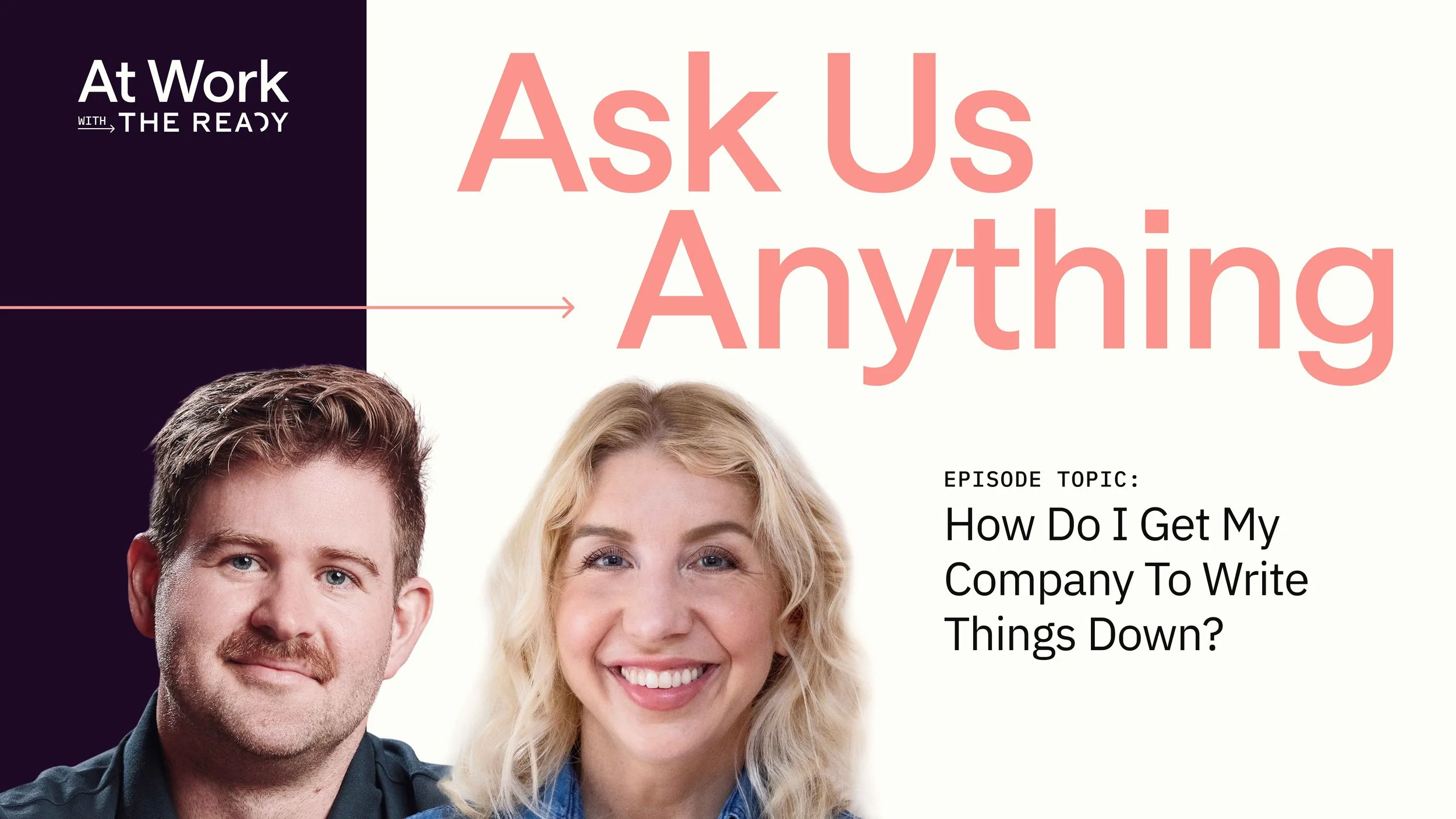
About this episode:
Original Air Date: September 28, 2026In some organizations, the knowledge isn't in a wiki or a handbook…it’s trapped in people's heads and travels by hallway storytelling. A listener wants to know: how do you build a culture of knowledge sharing and async communication in a place where writing things down has never been the norm?
In this mini episode, Rodney and Sam dig into why the oral tradition persists. From the power dynamics of hoarding knowledge to the fear of having receipts for decisions that went sideways, they share examples of how to lower the cost of sharing until working in the open becomes the path of least resistance.
Mentioned in this episode:
In this episode:

Rodney Evans

Sam Spurlin
Listen now:
Episode transcript:
Sam Spurlin:
Hey everyone. Welcome back to At Work with The Ready. I'm Sam Spurlin and I'm joined as always by Rodney Evans.
Rodney Evans:
Hey Sam.
Sam Spurlin:
Every other week we're tackling one tough though-provoking listener question and sharing a few ideas we think might help. Let's dive in. Rodney, what have you got for us this week?
Rodney Evans:
This week's question is how do you create and hold the space for creating a culture of knowledge sharing/working in the open/async comms in an org that has only ever relied on oral storytelling as the main method of knowledge management? What do you think, Sam?
How to harvest knowledge through interviews
Sam Spurlin:
So I'm realizing in my notes here, I'm making an assumption that there has been a resistance to a more kind of written approach to knowledge management. Maybe that's not the case and this organization has just never thought about really doing some systems work around knowledge management. And in that case, I think it's probably a more straightforward answer. So assuming there's a reason why it has stayed a predominantly oral tradition, where my head goes is, so there's a harvesting of the wisdom in this organization that needs to happen. And I think there are interesting fun ways to do that.
I think about in actually in undergrad, I took, what is it called....like an oral history class basically. I ended up interviewing my grandpa a bunch of times over the course of the semester to get that information that had only been kind of an oral tradition in our family. There's a version of that to be done in this organization potentially. How do we set up a rhythm of gathering around the folks who have the wisdom and kind of systematically extracting that through interviews? And I mean, this is very obviously a place I think where AI transcription and summarization would be a useful tool. So that's the straightforward part of it.
Why people horde knowledge and what they’re protecting
Sam Spurlin:
And then the other part where my brain goes is, okay, well why maybe has this organization resisted doing this in the past? There's probably a lot of power in having information, especially if it is not written down anywhere, you become the go-to person that people have to ask how we do things. And that gives you the reputational benefit of things like that. So if you really want to start to unravel it, you have to come at it through that lens as well. You're not going to have people voluntarily basically giving up their power in an organization unless they have a good reason to do so. So I think about, well, what are other more beneficial games to play in this organization other than kind of hoarding information and being the wisest one because you've been there the longest or something like that. And I don't know exactly what that could be, but I could imagine we could come up with some stuff through conversation and through kind of working with the question asker.
Rodney Evans:
Nice. I took a very different lens on this question because I think that from a leader's perspective, I'm going to take the empathetic tact here, which is there are a lot of leaders who are not necessarily amazing writers and who feel a level of insecurity about writing things down. And when you reach a certain altitude in an organization, there's a lot of scrutiny over things that are written because they can be and should be passed around. Often legal will look at things even that are just internal documents. Now people regularly leak internal comms to various media outlets or just post them online. And so I understand there's the less generous way of viewing this, which is like it's a lot harder to be pinned down when you can change your story a little bit for every room that you're in, but there's also -
Sam Spurlin:
Don't put it in writing!
Rodney Evans:
Yeah, don't put that shit in writing and then nobody can hold you to it, which is true. I'm not saying that that is not a real and valid part of this, but I also understand leaders' hesitance to sort of have these kinds of receipts on them at all times. So I just say that to say I think there is some underlying psychology and some fear that's warranted around writing things down generally, which is a requirement for what you're talking about in terms of knowledge sharing.
Use video and audio transcripts as a middle ground
Rodney Evans:
I also think that there are a lot of leaders who I've worked with over the years who do really rely on tone and style and ability to adapt on the fly based on their audience and that's super hard to do in writing. And so one way to maybe start making some moves this direction, and I'm not saying that this is just about a leader. I'm assuming that there's sort of this tradition of oral storytelling generally is can you start leaning into more like the sharing of Loom videos or the summarizing of transcripts from meetings? Because those things let people have a little bit more texture and a little bit more control rather than just like, I wrote this static thing one time and now it might haunt me forever. I think starting to shift in those ways to things that have more permanence, more shareability than just stories told in the hallway, but not the same level of formality and potential scrutiny as hardcore documentation. And again, I'm not talking about workflow processes. You got to just write that shit down. But because you specifically mentioned storytelling, I'm talking about stories and nuance and things that require narrative and context and whatever. And I think some of these alternative formats might be like a step in the right direction.
The real costs and benefits of working in public
Sam Spurlin:
Yeah, I think that makes a lot of sense. Last thought that I had on this was just in the realm of thinking about the asynchronous ways of working, making things visible. I've been doing a lot of work with an organization recently and it's helped me really think through the cost and benefits that people are thinking about or kind of weighing when deciding whether or not to kind of play ball in an asynchronous way of working. So by cost, I'm thinking of things like if you share kind of work in progress, are you getting kind admonished for not having high quality work? Are you basically being punished by sharing things that are not quite polished yet? Well, that goes directly against kind of an asynchronous writing things down sort of culture if that's what you're trying to create. Also thinking about, is it a huge pain in the ass to make things visible in terms of manual steps in a workflow or needing to copy and paste things like I'm doing the work over here, but I have to share it over here.
And now we have out of date things. So there's interesting things to be done with tooling to just make it easier to share things by default and not relying on people going above and beyond. So there might be kind of some things to think about there in terms of just how do we make this easier for folks? And then also what benefits do people get from it? If we're all kind of sharing things in a more open way, are certain roles able to get better information and therefore do their work easier? That's the type of thing where people will just naturally start doing this if it doesn't cost them very much and they get big benefits out of doing it.
Rodney Evans:
Love that.
Sam Spurlin:
All right, that is it for this mini. If you've got a question of your own, hit us up at podcast [at] theready [dot] com.
Rodney Evans:
And we will see you back next week for a full episode of At Work with The Ready. Thank you so much for being a listener.