
A Practical Guide to Cross-Functional Work

Byline: Ali Randel
For every organization, success requires transcending functional boundaries. Developing and selling a new product requires cooperation across sales, R&D, marketing, finance, and distribution. Creating a seamless user experience on a technology platform requires alignment across IT, communications, digital strategy, and marketing.
Almost nothing worth doing can be done in organizational isolation. Every leading company has developed ways to work across functional lines and come together around shared outcomes.
But according to research by Benham Tabrizi, nearly 75% of cross-functional teams are “dysfunctional,” defined as the inability to meet three of five criteria, including: staying on schedule, meeting customer expectations, and maintaining alignment with the company’s corporate goals.
These problems are pervasive, because the dysfunctions are caused by flaws in how we approach cross-functional work—not by incompetent people.
If we want high-performing cross-functional teams, we need to set up organizational systems that enable that behavior.
What Doesn’t Work
1. The Functional Matrix
The functional matrix is meant to increase information flow across silos, improve an organization’s ability to deliver integrated products/services to customers, and broaden the perspective of team members by having oversight from managers that sit in different contexts.
While well-intentioned, this structure is designed around the flawed archetype of the leader as the thinker and communicator. This places individual leaders as the primary (if not only) channel for passing information across boundaries, rather than building capacity for all members to contribute to that flow.
The functional matrix also typically places two or more leaders as the ultimate approvers of projects and decisions.
Best case, they’re aligned and pushing decisions up is just an inefficient use of time that reinforces the belief that middle managers and below aren’t capable of making good choices (they typically are). Worst case, these leaders are working toward different metrics and accountabilities, and the team is stuck in a swirl of politics and unclear priorities.
2. The Cross-Functional Oversight Committee
This flavor of committee is a group of people, usually folks deemed as experts in relevant fields, appointed to oversee the work, spending, and decisions of people doing the actual work.
There are a couple of benefits to this approach. First, it can create a clear outlet for tensions that arise throughout a project. Second, it promotes direct discussion between leaders about team objectives.
The downside? This structure promotes reliance on leadership to resolve disagreements and doesn’t clarify how conflicts should be dealt with at a team level. These conditions can create bottlenecks, slow team progress, and inhibit capacity building within the working team.
If teams are encouraged to always push decisions up to leaders, then leaders don’t have to share information with those teams—and team members don’t have to understand the strategy they’re working toward.
3. The Decision Tree
A decision tree outlines a predetermined path for a set of choices the decision-tree makers believe will come up for cross-functional team members. The idea is to outline a path for determining how certain tasks should be prioritized to execute a strategy that requires support from multiple functions, with defined checkpoints to get approvals and input from others.
There are a few major flaws with the decision tree.
First, it’s based on the assumption that employees can’t apply sound logic to choices based on the context they have. Not only is this not true, but it also actively discourages employees from taking ownership of their decisions and results.
Second, it operates with the assumption that work and priorities are static. This isn’t true 99% of the time. As soon as a strategy or checkpoint changes, a new decision tree needs to be drawn up, or the decision tree stays the same and provides inaccurate guidance.
Finally, if a decision tree is more than a few steps, it’s a safe bet it won’t be used. You’ve ended up discouraging good behavior by introducing a tool no one cares about.
4. The Cross-Functional Planning Team (with siloed execution)
In this scenario, stakeholders from different functions are pulled together to (hopefully) go through the messy process of integrating perspectives, compromising, planning next steps, and sharing a roadmap with their respective teams.
This is a great start—but it doesn’t put anything in place to maintain coordination as a project progresses. It’s based on the premise that the plan can be applied as is, and it doesn’t address the need for continuous communication that smart, fast pivoting requires.
As soon as the roadmap is passed to the executing team, different factors move the project onto a different trajectory, and project members have no clarity on how to navigate changes and emergent trade-offs.
What to Try Instead
Most attempts to create cross-functional capacity don’t address the factors that cause the dysfunction we want to eliminate:
Functional goals superseding shared outcomes
Unclear decision-making processes
No rhythm for communicating, collaborating, and learning
Lack of understanding concerning the functions of other team members
Instead of solving for team-level issues, we put practices in place that are at best temporary solutions, and at worst completely ineffective.
Let’s explore four tactics to improve cross-functional workflow, regardless of the structure you’re stuck in.
Four Cross-Functional Work Practices
1. Practice: Treat the work as a cross-functional project and the people working on it as a team.
If there’s cross-functional work, there are cross-functional projects—which means there should be real project teams. Frame the project as a team endeavor through the use of an official kick-off meeting and team charter.
This practice alone won’t remove competing commitments, but it can help strengthen relationships and generate more effective mindsets. Build a team identity by:
Clarifying the project’s purpose.
Identifying the core team members.
Building the foundation for psychological safety through some form of self-disclosure.
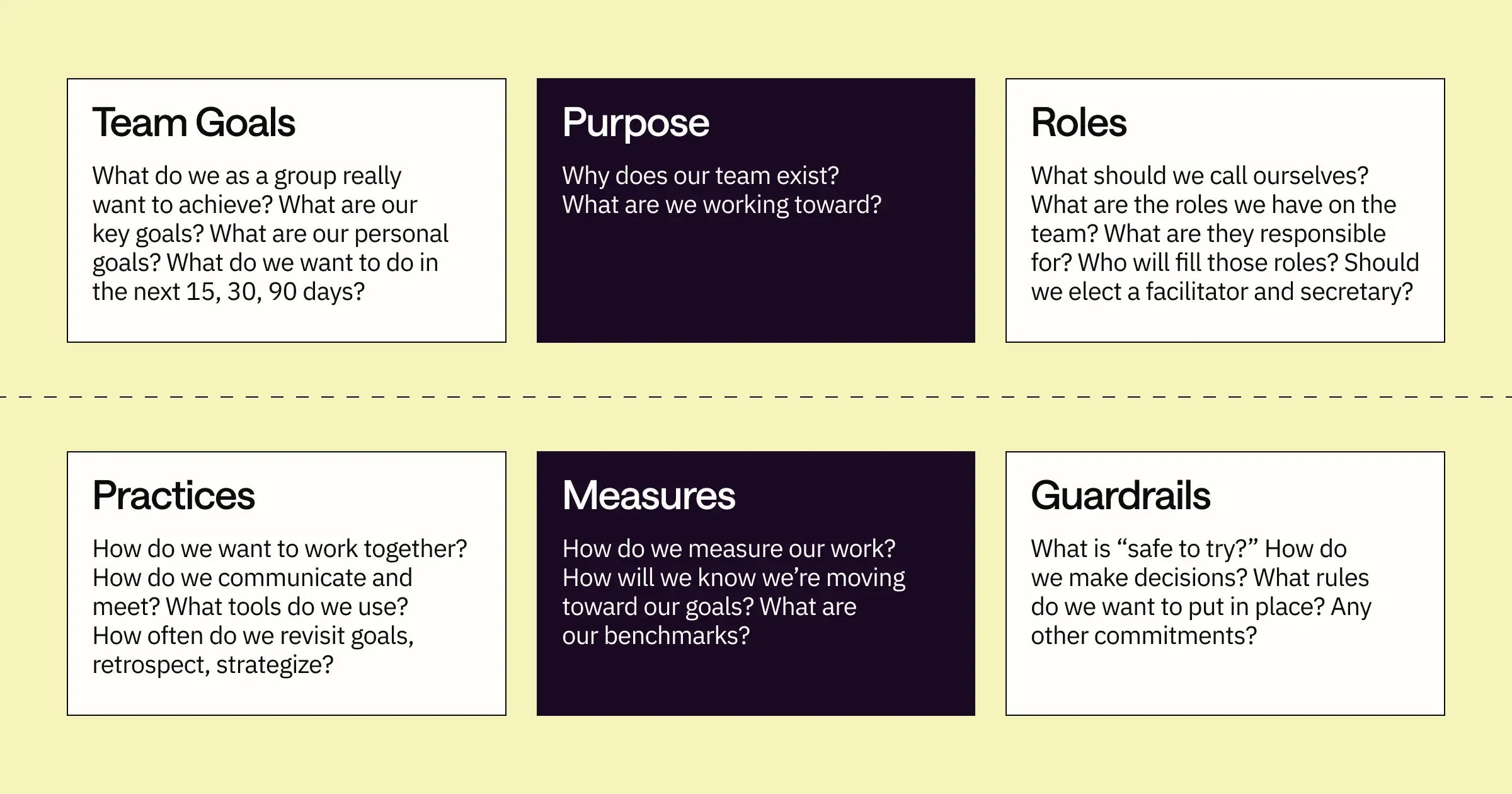
Tool: Team charter. Use the team charter pictured below as a guide for a kick-off meeting and to create a tangible artifact team members can reference. The image below is just one option; we often tailor team charters to specific projects.
2. Practice: Tackle competing commitments before tough decisions surface.
A big challenge in cross-functional work is negotiating the competing commitments of individuals who belong to different home teams. When teams agree to shared goals, problems often arise later over how to move toward those goals. Should we prioritize speed over quality? Do we care more about taking care of org debt or building new products?
These are the questions teams either get bogged down in or push up to leaders, because there’s no single right answer. If a team agrees on its prioritized competing commitments before that moment arises, an individual doesn’t have to think twice about what choice to make. It removes the need for recycled debates over conflicts that will show up again and again.
After a few months, teams should revisit the commitments they’ve prioritized and reevaluate whether they’re still the best way to get to their ultimate goal.
Tool: Even/Over statements. Agreeing on how to prioritize competing commitments can be tricky, because teams are often focused on diametrically opposing goals. Use a participatory process rooted in the current context and long-term goals.
Have team members come up with two to three Even/Over statements. The idea is to choose one good thing even over another good thing. They should refer to two good things that are typically in conflict with one another. Like “Market share even/over margin” and “Security even/over user experience.”
Have the team vote on its top three and get consent using the prompts, “Are these safe to try? Do they help us move toward our aim?” (Learn more about consent and team decision-making in this podcast episode.)
3. Practice: Establish a team rhythm that promotes collaboration, learning, and reflection.
Meetings are often not structured. Establishing a rhythm can help teams maintain awareness of each other’s workload, upcoming decisions, and decision outcomes. Structure is how you protect alignment around co-created goals, hold each other accountable, and collectively learn.
We coach teams to be deliberate about their operating rhythm. Instead of scheduling ad hoc meetings, we encourage them to schedule specific types of meetings at specific intervals.
Great cross-functional teams don’t leave their meeting rhythm to chance; they sweat it from day one.
Tool: Run a weekly Action Meeting. Explore Action Meetings more fully in this podcast episode, but here are the nuts and bolts:
Check-In Round: Everyone answers, “What has your attention right now?”
Checklist Review: Everyone answers, “Yes” or “No” to each checklist item (often used to encourage specific behaviors you want to see in the team).
Metrics Review: The team reviews the metrics that tell them whether they are on the right path.
Project Updates: One person per active project answers the question, “What’s changed on this project since last week?”
Build Agenda: Everyone adds topics to the agenda by calling out a placeholder word or phrase. The team focuses on topics that will unblock work in the coming week.
Process Agenda: Facilitator works through the agenda; everyone gets what they need to unblock the work.
Check-Out Round: Everyone answers, “What did you notice?”
4. Practice: Clarify decision rights and use a decision-making process to avoid the downfalls of consensus.
Many of the problems with cross-functional work emerge when decisions are made in isolation, when over-collaboration turns into an ineffective effort to create consensus, or when general debate about who can make the final call for what drags on. These tensions can be avoided by clearly defining who can make what decisions on their own, when decisions require the advice of cross-functional partners, and when decisions require the integration of many perspectives.
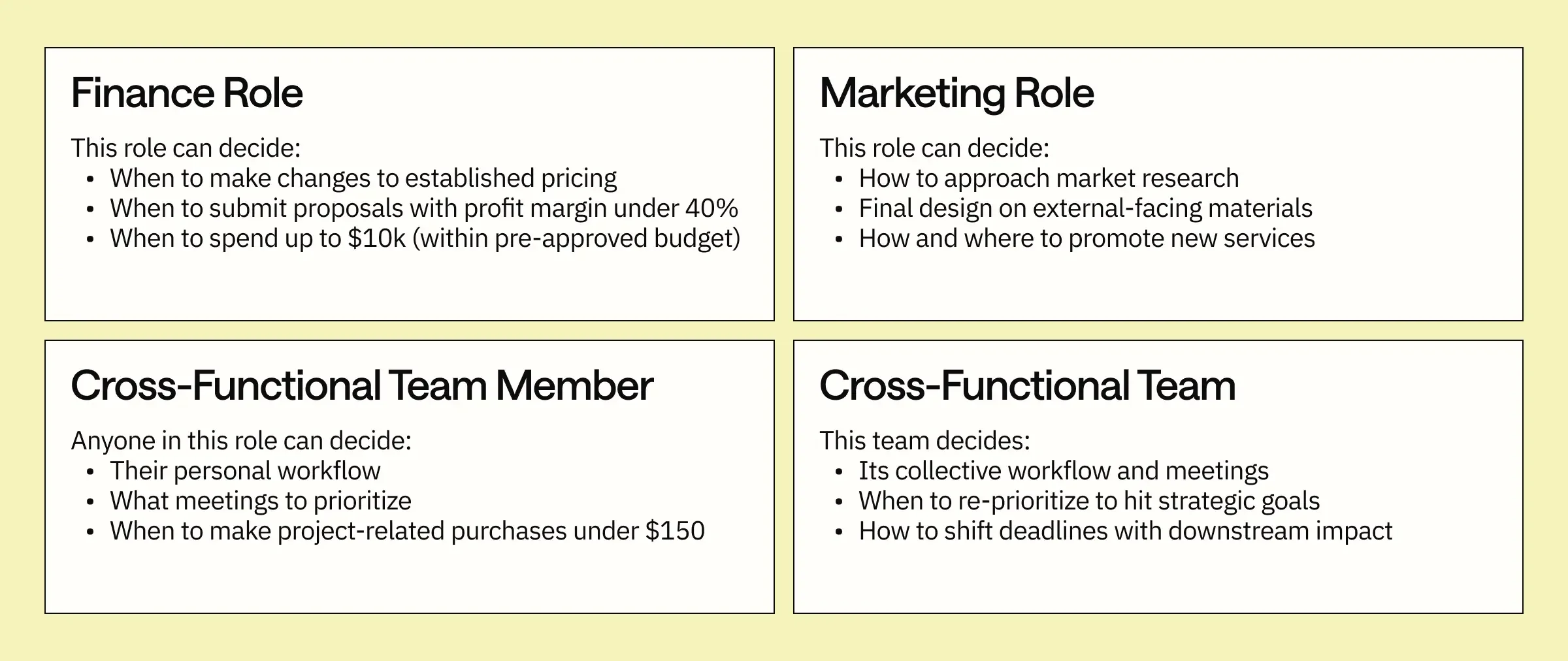
Tools: Decision rights and integrative decision-making. Decision rights can outline what decisions specific roles (CFO), shared roles (finance team members), and/or discrete teams (finance) have the authority to make on their own.
Have teams and team members draft their decision rights independently and then have a session to present and debate those drafts. Decision rights should be directly linked to a team’s purpose and accountabilities. Use the integrative decision-making process to finalize the outcomes.
Some examples:
With practice, even the gnarliest of decisions can be made without the angst most cross-functional teams know all too well.
Cross-Functional Work as a Discipline
While certain structures make cross-functional teaming easier, the organizations with the most success know cross-functional collaboration is a discipline. Breaking down silos is about using specific practices and internalizing helpful principles as much as it’s about using—or not using—particular organizational structures.
Try using some of these behaviors and tools before taking a hammer to your org chart.